Defence Infrastructure Organisation Ethical honeybee management in Service family accommodation

Speak to an expert about your challenge

Related markets and services

At Amey, we support the Defence Infrastructure Organisation (DIO) by managing the defence estate in a way that is safe, compliant and sustainable, while safeguarding Service family welfare. Across the estate, honeybee colonies are occasionally discovered within Service family accommodation and other occupied buildings. With colonies often containing between 50,000 and 60,000 bees, unmanaged or inappropriate removal presents risks to occupant safety, building integrity, and biodiversity.

At a glance

  • We support the DIO in their mission to enhance biodiversity and adopt ethical methods for dealing with protected species.
  • Honeybees are vital pollinators and are needed to maintain biodiversity and ensure food security. In 2020 Defra launched the Healthy Bees Plan 2030 to help protect honeybees and other species.
  • Honeybee colonies require specialist removal due to their complexity, as well as the risks posed to buildings.
  • Working with Beegone, we can deliver chemical‑free bee extractions that protect the brood comb and ensure colony relocation, while preventing long term structural damage to building fabrics.
  • This approach supports biodiversity and ensures a safe, sustainable outcome for our clients, the residents and the environment.

Key metrics

  • 13

    removals

  • 100%

    extraction success

  • 200,000

    plus bees saved

In response, we implemented a specialist, ethical approach to honeybee management that protects residents, preserves valuable defence assets and supports DIO’s environmental and sustainability commitments.

The challenge: removing well-established honeybee colonies while protecting biodiversity

Each year, around 10–20 honeybee removal tasks are reported to Amey. In many cases, these are initially reported by Service families as “wasps”. While our pest control partner, Ecolab, manages wasp activity, they do not remove honeybees, so once identified correctly, tasks must be escalated for specialist intervention.

Honeybee colonies are often well-established, with some nests several years old and embedded within the building fabric. If not managed correctly, this can lead to increased risks to occupant safety, the deterioration of building fabric, repeat infestations, and higher long term maintenance costs for the DIO.

Poorly managed removal also poses a significant risk to the loss of the colony, impacting biodiversity. This makes a specialist, live-removal approach essential.

Our approach: implementing specialist, ethical techniques that address the complexity of each removal

Once confirmed as honeybees, we work with Beegone, a specialist provider of live, chemical-free bee removal. No insecticides are used at any stage of the process.

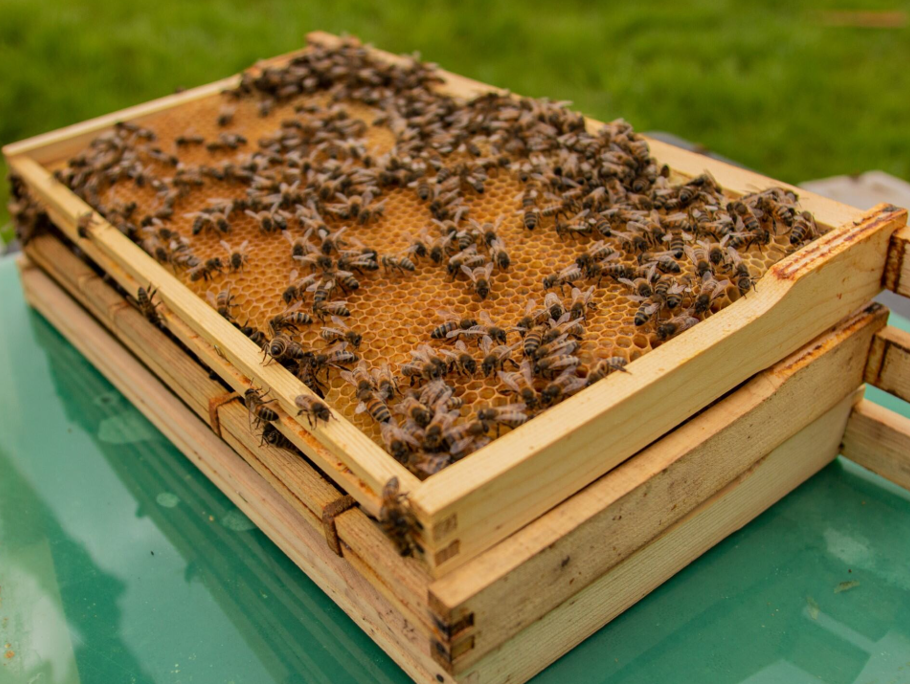
Beegone’s technicians use a range of techniques depending on the complexity of the task. These include calming bees with smoke, carefully removing honeycomb and brood comb, and identifying and securing the queen bee. In many cases, the queen is placed in a specialist clip, encouraging the colony to follow her and ensuring a coordinated relocation. For more complex extractions, a bee vacuum is used to gently collect bees directly into a transport box.

Protecting the brood comb is critical, as this is where eggs are laid and colony survival depends on it. Colonies typically contain 50,000–60,000 bees, although one recent extraction involved safely relocating over 100,000 bees. Thanks to Beegone’s expertise, Amey has achieved 100% queen-capture success to date, with no brood comb loss recorded across any extraction.

Once secured in a nuc box, colonies are transported to Beegone’s apiaries where they are re-established. Where distance makes relocation impractical, Beegone works with local charities or beekeepers to ensure colonies continue to support local biodiversity.

Following every extraction, the team reinstates affected building fabric and bee-proofs the area to prevent recurrence, protecting both the structure and the wellbeing of residents.

Our approach was designed to support DIO’s objectives for safe estate management, that provides a cost-effective solution, while also ensuring environmental stewardship that is delivered to a consistently high standard.

The outcome: safe and resilient estate management

Since we started working with Beegone last year, we have achieved 13 removals and saved over 200,000 bees. By choosing a complex but ethical approach we are supporting the DIO in meeting its responsibilities for estate safety, Service family welfare and environmental stewardship.

Each successful removal is reducing the risk to occupants, preventing long term damage to defence assets and delivering measurable biodiversity benefits. The approach also provides reassurance to Service families, demonstrating that environmental responsibility and resident safety are not mutually exclusive.

This work also aligns directly with Biodiversity Net Gain (BNG) principles and reflects our commitment to doing the right thing, even when it requires additional expertise, care, and effort.

Our work with Beegone supports the DIO priorities for safe and resilient estate management, Service family welfare and sustainable use of the defence estate.

Speak to an expert about your challenge.